There’s a certain shade of green that only exists in the Sequatchie Valley in late spring.
It arrives somewhere between dogwood season and the first cutting of hay — when the hardwoods on the mountainsides finally leaf out completely, the pastures glow bright emerald after sunrise, and the long gray look of winter disappears almost overnight. Around here, folks simply call it the “green-up.” And it’s the perfect time to get out and take in the season before the heat and humidity settle in.
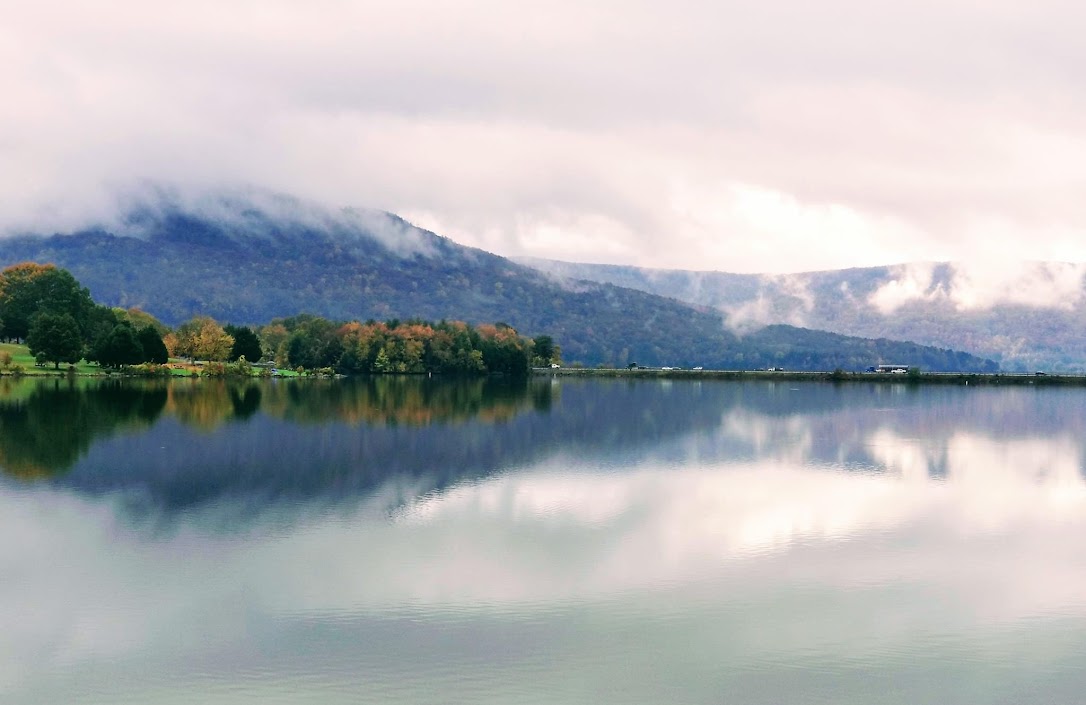
Morning fog over the valley at Nickajack Lake – Photo: Logan Carmichael
Growing up in Whitwell, I never fully realized just how special this time of year really was. Around here, you almost assume everybody wakes up to mountain fog settling into the valley at daybreak, honeysuckle climbing old fence rows, and the smell of fresh-cut grass drifting through the air by late afternoon. But once you leave — even for a little while — you begin to understand there are very few places quite like this stretch of Tennessee. Maybe that’s why I never stayed gone very long myself. I wandered a little into Chattanooga and North Georgia for a time, but it didn’t take long before the pull of home, the mountains, and the valley brought me right back.
The Sequatchie Valley in mid-to-late May feels alive in every direction.
Along the backroads of the valley, blackberry bushes are beginning to bloom. Wild roses cling to old fence posts. Mountain laurels (commonly called Ivy in the Appalachian region) are opening up across the plateau edges, while rhododendrons are beginning to show in cooler hollows and creekbeds. Kudzu hasn’t fully taken over yet, but it’s waking up. Corn fields are sprouting. Tomato plants are already staked in backyard gardens, and local farmers markets will soon begin filling with squash, cucumbers, onions, strawberries, and the season’s bounty of sweet early-season produce.
This year, though, the valley carries one major concern: rain.
Like much of Tennessee, the Sequatchie Valley has been unusually dry heading into summer. Creeks are running lower than normal for May, lawns are browning faster than they should, and farmers are watching the skies closely. Afternoon thunderstorms — normally a regular feature this time of year — have been scattered and inconsistent.
Still, the weather pattern itself remains familiar.
Late May here usually means warm afternoons in the upper 70s and 80s, humid evenings, foggy mornings, and the occasional powerful thunderstorm rolling off the Cumberland Plateau. Memorial Day weekend has long served as the unofficial beginning of summer across the valley. Pools open. Campgrounds fill up. Boats return to Nickajack Lake. The sound of cicadas begins building in the woods. And somewhere, somebody is already setting up a fireworks stand.
That seasonal rhythm is part of what makes this area special.
From almost any point in the valley, you’re surrounded by dramatic geography. To the west rises the towering escarpment of the Cumberland Plateau. To the east stands Walden’s Ridge and the rugged mountain spine separating the valley from the broader part of the Tennessee Valley. Southward, Sand Mountain begins stretching into Alabama as the landscape rolls slowly lower on its eventual dip into the Gulf.
And in late spring, every overlook becomes postcard-worthy almost as much as the fall.
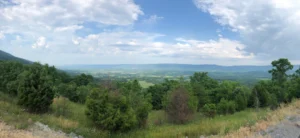
Scenic Overlook on TN-111 – Photo: Wikipedia
Driving on Tennessee State Route 111 out of Dunlap offers some of the best scenery in Tennessee. The Scenic Overlook along the mountain provide sweeping views across the valley floor as farmland, church steeples, and winding roads spread out below. Fog often settles into the valley adding for even more moody and dramatic scenes for the aspiring photographers that enjoy these views.
Meanwhile, U.S. Route 127 delivers its own quieter beauty, especially around Pikeville and Bledsoe County where rolling farmland meets plateau cliffs and hidden coves.
One of my favorite views anywhere in the region sits above Whitwell at the Tennessee Tree Toppers Hang Gliding Association Launch off Mt. Olive Road atop Whitwell Mountain . On clear days and evenings, you can stand near the launch point and see miles across the Sequatchie Valley and even into the distant Tennessee Valley as the mountains fade blue into the distance. Hang gliders frequently launch from the site this time of year, floating silently above the valley like giant birds riding thermal currents.
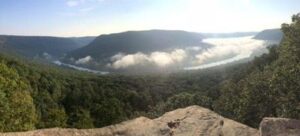
Snooper’s Rock and TN River Gorge – Photo: Wikipedia
Just beyond here on the eastern edge of the valley sits another treasure many Tennesseans still overlook entirely: the Tennessee River Gorge — often called the “Grand Canyon of the Tennessee River.” The river cuts dramatically through the mountains creating one of the most scenic waterways in the Southeast. Kayakers, boaters, paddleboarders, and fishermen spend late spring exploring the Tennessee River and hikers can enjoy the trails above it. Few overlooks in the Southeast rival the view from Snoopers Rock, perched high above the Tennessee River Gorge. From the sandstone overlook, the Tennessee River winds through the mountains below in dramatic fashion with one of the most breathtaking and unforgettable views anywhere in the region.
Then there are the waterfalls.
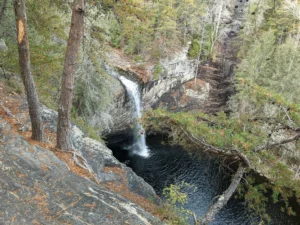
Foster Falls – Photo: VisitMarionCountyTN.com
Late spring is prime time for hiking throughout Tennessee State Parks properties across the region. Though dry conditions have reduced some flows this year, places like Fall Creek Falls State Park, Foster Falls in the South Cumberland State Park, and Savage Gulf State Park remain stunning this time of year with deep green forests, sandstone cliffs, ample hiking trails, and cool mountain streams.
One place I always encourage people to visit is the Head of the Sequatchie inside Justin P. Wilson Cumberland Trail State Park. It’s easy to overlook if you’re unfamiliar with the area, but it’s one of the most geographically unique spots in Tennessee — the place where the Sequatchie River begins flowing out from beneath the mountain from Grassy Cove above it. Surrounded by forest and limestone, it feels ancient and almost hidden…mythical in a way, despite being an easily accessible with a paved trail, short gravel loop, right off the site’s parking lot.
And speaking of hidden places, few areas carry more simple beauty and a tinge of Southern lore than the aforementioned Grassy Cove.
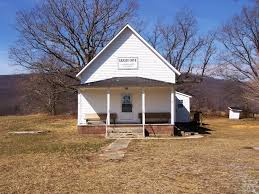
Grassy Cove Community Center – Photo: Community Center Facebook Page
Located high atop the Cumberland Plateau, Grassy Cove is Tennessee’s largest sinkhole and historically one of the state’s most isolated communities. Surrounded almost entirely by mountains, the cove remained difficult to access for generations, helping preserve not only its farmland and quiet rural beauty, but also the folklore and mystery that still surround it today.
Stories of moonshiners, family feuds, hidden caves, and strange happenings remain part of local conversation. What makes the cove even more fascinating is what happens beneath it — water draining from Grassy Cove disappears underground into Devilstep Hollow Cave before eventually emerging again below the cove at the base of Brady Mountain as the headwaters of the Sequatchie River.
There’s admittedly not a whole lot “there” in Grassy Cove in the traditional tourist sense, but that’s part of the charm. Taking the drive along Tennessee State Route 68 between Grandview and Crossville through the cove is absolutely worth it for the scenery, the geology, and the feeling that you’ve stumbled upon one of Tennessee’s hidden worlds.
That same feeling of preserved tradition and slower living can also be found just above Dunlap near Spencer in the Fall Creek Falls Mennonite Community, tucked away along the rural backroads surrounding Fall Creek Falls and Brockdell Mountain. The community, which traces its roots to Mennonite families settling in the area decades ago, continues to live much as earlier generations did — with farming, craftsmanship, faith, and simplicity still central to daily life. Horse-drawn buggies occasionally share the road with modern traffic just a few miles off Tennessee State Route 111, creating a scene that feels increasingly rare in today’s fast-paced world.
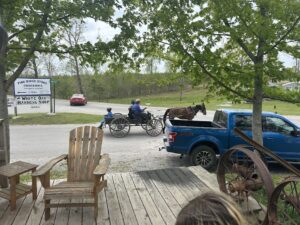
Scenes from the Fall Creek Mennonite Community – Photo: Logan Carmichael
Scattered throughout the community are family-run produce stands, greenhouses and nurseries, bakeries, bulk food stores, furniture shops, and small general stores offering everything from fresh vegetables and canned goods to handmade furniture, flowers, jams, baked goods, pantry staples, hardware and lumber items, and handcrafted items–not to forget fantastic sandwiches, burgers, hand pies (fried pies), and more. In late spring especially, the area comes alive with hanging flower baskets, vegetable plants, fresh strawberries, and locally grown produce.
Part of the charm is that nothing about the experience feels overly commercialized. Most businesses are open during daylight hours on weekdays and Saturdays in season, while Sundays are reserved for church and family and the various stores are closed. Visitors should bring cash since shops do not accept cards, and ATMs are nowhere to be seen. The community is known for being welcoming and genuinely kind to visitors, and while modest dress is appreciated out of respect for local customs, you’ll find the atmosphere warm, peaceful, and refreshingly down-to-earth.
And this time of year, communities across the region begin celebrating the season itself.
Small-town festivals, bluegrass gatherings, antique tractor shows, church homecomings, and Memorial Day (often still called ‘Decoration Day’) events, car cruise-ins and shows and much more begin filling calendars throughout the valley. Nearby communities host seasonal events celebrating music, food, crafts, and Appalachian heritage–we’ll get to all of those another time because there’s just so much!
But honestly, some of the best moments this time of year aren’t festivals at all.
They’re the quiet ones.
Watching sunlight break through fog near the river at dawn. Driving across the valley as thunderheads build over the plateau. Sitting on a porch listening to whip-poor-wills after dark. Stopping at a roadside stand for fresh strawberries. Catching the smell of honeysuckle while driving with the windows down.
Late spring in the Sequatchie Valley doesn’t just look beautiful.
It feels like home.